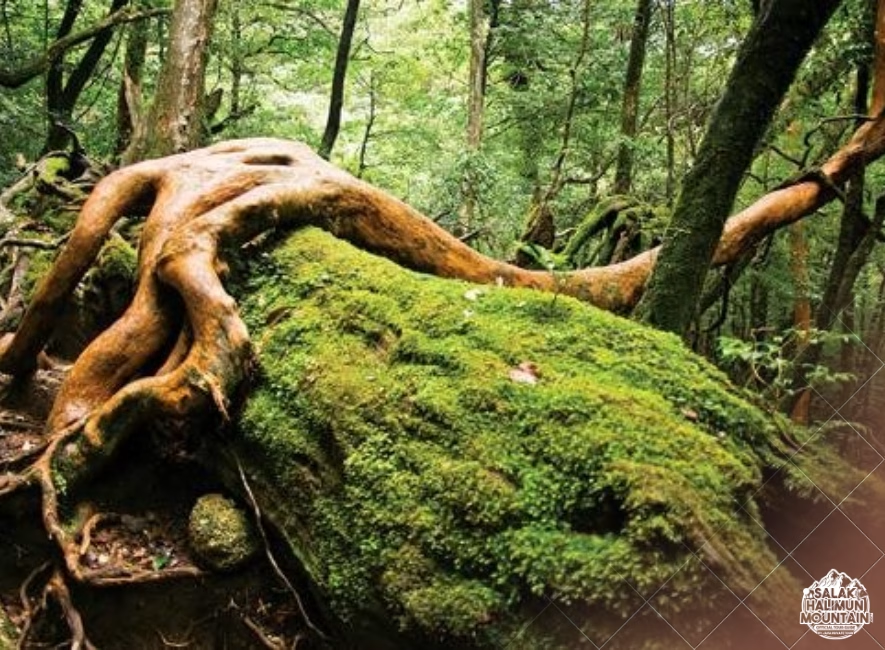
salakhalimunmountain.com – Trekking through the dense, high-humidity rainforests of Mount Salak and Halimun National Park places you in an environment where moisture dictates every aspect of natural growth. From towering volcanic rock walls to the gnarled trunks of ancient montane trees, the landscape is wrapped in vibrant carpets of green bryophytes, commonly known as moss. While traditional outdoor lore often teaches that moss grows exclusively on the north side of trees, tropical wilderness navigation demands a much more nuanced understanding. Learning how to read moss growth for directional cues in an equatorial rainforest requires looking past old rules and analyzing micro-climates, wind patterns, and moisture dynamics.
In temperate zones, solar angle creates a distinct shade preference that makes moss a reliable compass indicator. However, in West Java’s tropical latitudes near the equator, the sun tracks almost directly overhead year-round, eliminating consistent north-south shade differentials. Instead, moss growth is driven by local moisture channels, prevailing wind-driven mist, and structural canopy shadows. By mastering how to interpret these micro-environmental factors, you can use moss distribution as a secondary navigational aid to confirm your orientation on remote mountain trails.
The Tropical Reality of Moss Growth Factors
To use moss as a reliable indicator, you must first understand what moss actually needs to thrive. Moss is a non-vascular plant that lacks true roots; it absorbs water and nutrients directly through its leaves from the surrounding air and moisture films on surfaces. Consequently, moss does not grow based on magnetic points of the compass—it grows strictly wherever moisture, shade, and substrate stability intersect.
On Mount Salak, atmospheric humidity is exceptionally high, often exceeding ninety percent near upper ridge lines and crater zones. With moisture readily available on all sides of a tree trunk or boulder, moss can easily coat every surface if light conditions permit. Therefore, relying on the old adage that “moss grows on the north side” will quickly lead you astray in a tropical rainforest. True directional tracking requires analyzing relative density and growth thickness rather than simple presence or absence.
Distinguishing Micro-Climatic Aspect vs. Cardinal Direction
Instead of looking for cardinal directions, trained rainforest trackers look for aspect-driven micro-climates. Slopes facing south and southwest on Mount Salak frequently bear the brunt of moisture-laden monsoon winds pushing up from the Indian Ocean, resulting in heavier precipitation and denser, more luxurious moss colonies on windward-facing rock faces and tree trunks.
Similarly, deep gullies and ravines create perpetual shade and damp air funnels that encourage 360-degree moss coverage. When evaluating a tree trunk for directional clues, observe which side features the thickest, most saturated carpet of moss compared to the sparser, drier patches. The denser moss growth usually points toward the primary moisture source or prevailing wind channel rather than a specific magnetic pole.
Reading Tree Trunk Patterns and Canopy Shadows
Within a dense forest canopy, sunlight filters through in scattered, uneven beams. The side of a tree trunk that receives the least direct sunlight and the most protection from drying morning winds retains moisture longer, creating an ideal nursery for epiphyte and moss spores.
Observe the distribution of moss around individual, isolated large canopy trees rather than tightly packed thickets. The side of the trunk facing away from midday sun angles or sheltered from prevailing wind-driven rain often shows a longer vertical streak of soft, velvety moss extending down toward the soil. By noting which side of prominent trailside trees holds the thickest collar of moss, you establish a consistent baseline for local aspect.
Substrate Porosity and Bark Texture Variations
When reading moss growth, you must also factor in the physical characteristics of the surface it clings to. Different tree species possess bark with varying levels of water absorption, pH, and texture, which dramatically influences how well moss can establish roots.
Rough-barked hardwoods—such as old-growth figs and vintage forest chestnuts—trap moisture in their deep vertical fissures, encouraging thick moss lines. Smooth-barked trees shed water quickly and rarely support heavy moss growth regardless of direction. Always compare moss density between trees of the same species to ensure your directional observations are based on environmental micro-climates rather than bark chemistry.
Boulder Fields and Volcanic Rock Formations
Rock formations offer some of the most stable, reliable surfaces for reading micro-climatic moss patterns on Mount Salak. Volcanic basalt boulders scattered across ancient lahar flows or hidden beneath deep rainforest canopies retain moisture differently than organic soil.
Inspect large, stationary boulders along your route. The upward-facing top surfaces of rocks receive intense rainfall and direct leaf drip, which can scour away delicate moss or encourage algae overgrowth. The vertical and slightly overhanging flanks of the boulder, however, receive gentle, mist-borne moisture and ideal shade. Notice if moss coverage is heavily concentrated on one specific face of the boulder field—such as the upslope side facing a drainage ravine—which indicates the direction of heavy ground humidity flow.
Using Valley Bottoms vs. Ridge Crests to Calibrate Observations
Moss growth density changes dramatically depending on whether you are standing in a protected valley floor or an exposed ridge crest. In deep river valleys, ambient humidity is uniformly high, causing moss to blanket everything in sight.
As you climb higher onto exposed ridge shoulders and sub-peaks, drying winds increase and moss becomes restricted entirely to sheltered micro-gaps, root cavities, and the lee side of tree trunks. By observing how moss distribution shifts as you change elevation, you can calibrate your understanding of how wind and altitude interact with local moisture, turning a simple patch of green into a sophisticated altitudinal and directional indicator.
Integrating Moss Cues with Primary Navigation Tools
It is essential to treat moss growth as a supplementary cue rather than a standalone navigation system. In tropical environments, micro-climatic variables can easily create false positives, such as a localized stream eddy creating dampness on an unexpected side of a tree.
Always cross-reference your moss observations with primary navigational instruments, such as a magnetic compass, altimeter readings, and visible slope contours. If your compass indicates you are heading east down a spur ridge, check the moss patterns on prominent trees to see if they align with the windward moisture side you identified earlier. Combining biological indicators with hard instrument data ensures robust, multi-layered situational awareness.
Respecting Forest Ecology When Observing Flora
As you study moss growth and forest micro-features for navigation, remember to practice responsible wilderness ethics. Moss carpets are fragile ecosystems that take decades to establish across volcanic rock faces and tree trunks.
Never peel back, scrape off, or trample moss layers to inspect underlying bark or check soil moisture. Observing visual density from a respectful distance is more than enough to gather the directional cues you need. Preserving the delicate biological balance of the forest ensures that the living canvas of Mount Salak remains pristine for future explorers.
Mastering the art of reading moss growth adds an intuitive, deeply connected layer to your wilderness skillset. While tropical moss does not point mechanically to the North Pole like a compass needle, understanding how moisture, wind, and shade shape its distribution helps you read the living pulse of the rainforest. By tuning into these subtle botanical details, you navigate the breathtaking wilderness of Mount Salak and Halimun with enhanced observational depth and total self-reliance.
So, if you’re ready to explore the wonders of Mount Salak Halimun, head over to our ONLINE BOOKING PAGE and let’s start planning your adventure. Or simply CLICK THIS LINK to chat with us on WhatsApp.
With our team, you’re not just getting a guide; you’re gaining a local friend who will ensure your trip is nothing short of extraordinary.